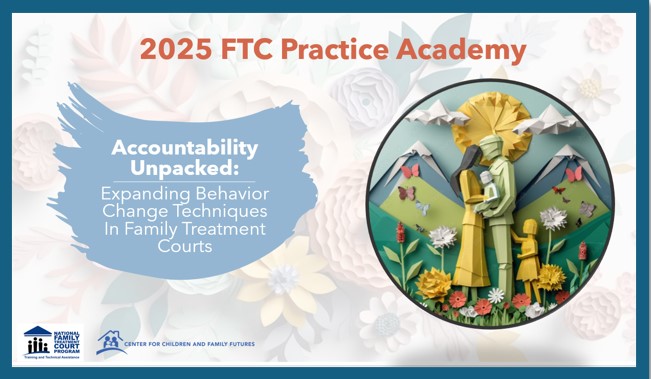
Accountability Unpacked: Expanding Behavior Change Techniques in Family Treatment Courts
About
Behavior change is complex, especially for individuals with substance use disorders, mental disorders, or executive functioning challenges. Treatment courts traditionally use three major behavior change theories: the transtheoretical model, operant learning theory, and goal-setting theory, which inform sanctions, incentives, and motivational interviewing practices. However, with over 80 behavior change theories in the social sciences, a wealth of knowledge is available to further enhance treatment court practices.
This year’s Practice Academy reviews and expands on behavior change theories, utilizing the Behavior Change Wheel1 —a comprehensive framework for understanding and changing behavior developed from 19 behavior change models. Teams will learn to integrate a broader range of techniques, identify barriers and enablers to behavior change, and foster collaboration while better addressing participants’ needs.
Learning Objectives:
- Review and expand on behavior change theories in treatment court practices using the Behavior Change Wheel.
- Apply a structured framework to identify barriers and enablers to change and develop individualized responses to support participants’ needs and goals.
- Foster effective teamwork and communication while collaboratively responding to participant behavior.
5-Part Video Series
Watch these five short, engaging videos covering key topics like accountability vs. punishment, behavior change theories, when nothing seems to work, and more.
Behavior Response Toolkit
The Behavior Response Toolkit helps family treatment court (FTC) teams respond to participant behaviors using a structured, evidence-informed approach. Grounded in the Behavior Change Wheel and COM-B (Capability, Opportunity, and Motivation – Behavior) models of behavior change, the toolkit supports teams in identifying conditions present or missing for behavior change, selecting appropriate interventions matched to the identified condition, and promoting accountability without punishment.
Live Event Recording
On September 16, 2025, CFF hosted a live event – Behavior Change in Action: Introducing the Behavior Response Toolkit. This webinar walked through some key points of the videos and toolkit, then spotlighted a panel of practitioners who’ve piloted the toolkit in the field. See below for the recording and slides from the event.
Event Slides
1 Michie, S., Atkins, L., & West, R. (2014). The behaviour change wheel: A guide to designing interventions. Silverback Publishing. https://www.behaviourchangewheel.com
Learning Opportunities
Grantee TTA Projects

OJJDP and CFF currently offer in-depth technical assistance to six Statewide System Improvement Program (SSIP) Awardees: Alabama, Colorado, Iowa, Ohio, New York, and Guam. Find out more about how these states are implementing systems reform to expand FTCs’ scale and scope—increasing FTCs reach into child welfare and substance use disorder treatment systems and ensuring the delivery of a full range of comprehensive services for families.

In 2016 the Office of Juvenile Justice and Delinquency Prevention funded 12 FDCs. This funding opportunity aligns with the national FDC movement working to increase FDC’s capacity and scope of services to children and families. Of the 12 new OJJDP grantees, six sites were awarded implementation funding to create new FDC programs within their jurisdictions and six were awarded enhancement funding to expand the capacity and augment services among their existing FDC programs. Three tribal sites were awarded implementation funding to help bring Tribal Healing to Wellness Courts to tribal jurisdictions.